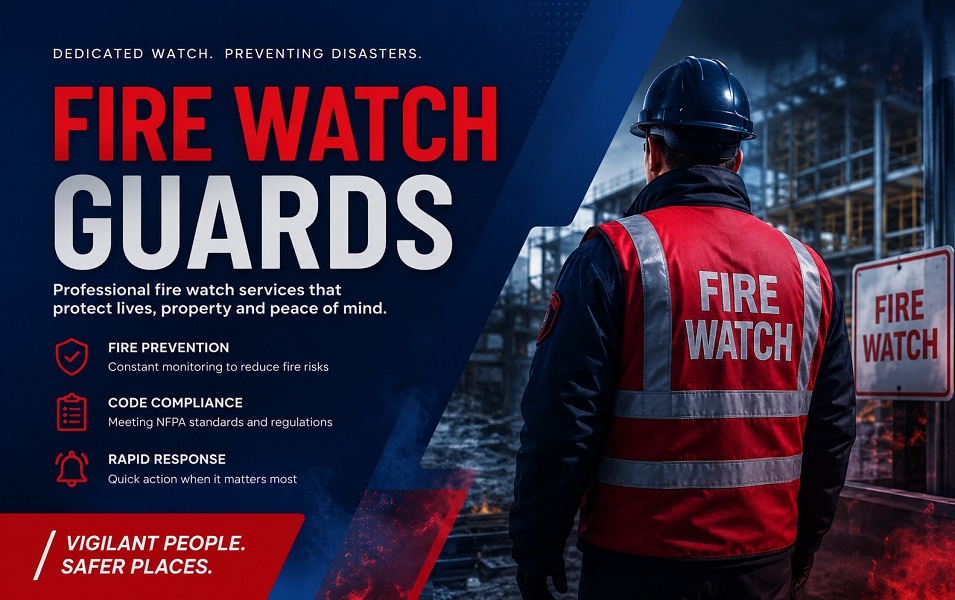
There’s a moment every fire investigator knows well — the point of origin. That small, overlooked spark, the unattended welding station, the sprinkler system quietly offline for 72 hours. Most fires don’t announce themselves. They build in silence, in corners that nobody thought to check. That’s precisely where Fire Watch Guards change everything.
These trained professionals are not simply security personnel with a different title. They are the bridge between a potential catastrophe and the moment someone catches it in time. Deployed across construction sites, hospitals, manufacturing plants, hotels, and high-rise developments, fire watch guards represent one of the most underestimated layers of modern risk management.
The Stakes Are Higher Than Most Businesses Realize
According to OSHA and the National Fire Protection Association (NFPA), fire watch services are legally mandated whenever a building’s fire suppression or alarm systems are temporarily offline — whether due to maintenance, malfunction, or construction activity. Yet many business owners treat this requirement as a bureaucratic checkbox rather than a genuine lifeline.
That instinct is dangerously wrong.
A single undetected fire during a system outage can obliterate years of revenue, destroy irreplaceable infrastructure, and — most critically — cost lives. The liability exposure alone can bankrupt a mid-sized company. What fire watch guards do, at their core, is compress the window between ignition and intervention to nearly zero.
What Happens During Every Single Patrol
Every 15 to 30 minutes, a trained fire watch guard moves through a designated area with a specific, disciplined eye. They’re not wandering. They’re scanning electrical rooms for overheating equipment, checking storage areas for improperly stored flammable materials, verifying that emergency exits remain unobstructed, and monitoring hot work zones where welding, grinding, or cutting is actively occurring.
This rhythm — patrol, document, report, repeat — is deceptively simple. But the discipline behind it is what makes it powerful. Human perception, trained and focused, catches anomalies that automated systems miss. A sensor doesn’t smell burning insulation. A camera doesn’t notice that a fire extinguisher has been moved from its station. A guard does.
The documentation produced during these patrols isn’t administrative busywork either. Time-stamped patrol logs, hazard reports, and corrective action records become critical evidence during insurance reviews, fire marshal inspections, and — in the worst cases — legal proceedings.
Hot Work Sites: Where the Risk Multiplies Fast
No environment demands fire watch coverage more urgently than an active hot work site. Welding, torch cutting, and grinding generate thousands of sparks per minute, many of which travel farther than workers expect. Embers can settle into wall cavities, insulation foam, or piles of debris and smolder undetected for hours before igniting.
OSHA standards require that a fire watch remain on post not just during hot work operations, but for a minimum of 30 minutes after all work has stopped. That post-work window is when many fires actually start — after the crew has packed up and assumed the risk is over.
Experienced fire watch guards understand this timeline intuitively. They don’t leave when the work ends. They stay, patrol, and verify — because they know that the most dangerous moment is often the quiet one after the noise stops.
The Legal Architecture Behind Fire Watch Requirements
Fire watch isn’t optional. It’s codified. NFPA 101 (Life Safety Code), NFPA 51B (Hot Work Operations), and OSHA 29 CFR 1926.352 collectively establish clear legal obligations for property owners, general contractors, and building managers. Violations can result in immediate stop-work orders, substantial fines, and — in the event of a fire — devastating civil litigation.
Certified fire watch providers deploy guards who understand this regulatory landscape in detail. They know which permits are required, which documentation formats satisfy local fire marshal requirements, and how to coordinate in real time with fire departments and emergency response teams. That institutional knowledge is part of what separates a professional fire watch operation from simply hiring a general security guard and handing them a clipboard.
When a building’s sprinkler system goes down for emergency repairs, the clock starts immediately. Leading fire watch companies now offer deployment in under three hours to any location in the country — because the moment a suppression system goes offline, the legal and physical risk begins.
Beyond Compliance: The Psychology of Prevention
There’s a concept in safety science called “normalization of deviance” — the gradual process by which people begin accepting risk as normal because nothing bad has happened yet. It’s how experienced crews start leaving fire extinguishers misplaced. It’s how cluttered exits get ignored for weeks. It’s how sparks near flammable material become “not a big deal” on a busy job site.
Fire watch guards disrupt that psychology simply by being present and vigilant. Their presence raises the behavioral standard of everyone around them. Workers become more careful when someone trained specifically in fire hazard identification is walking the floor. Supervisors become more responsive. Site culture shifts — measurably — toward prevention.
This is the invisible return on investment that rarely appears in fire safety literature but is felt acutely on any site where a professional fire watch program has been properly implemented.
Coordination, Communication, and Crisis Response
When a hazard is identified — or when fire actually breaks out — the fire watch guard’s role transforms instantly. The protocol is precise: activate alarms, notify emergency services, initiate evacuation, account for personnel, and support first responders with real-time information about the building’s layout, the location of the fire, and which systems are functional.
That last point matters more than most people realize. When a fire department arrives at a commercial building in distress, they need information fast. A fire watch guard who has been patrolling that facility and knows it intimately becomes an invaluable asset. They can tell responders where the hot work was happening, which exits are unobstructed, and whether there are hazardous materials in specific areas.
This coordination capability is what elevates fire watch from simple surveillance to an integrated component of a building’s overall emergency response architecture.
Choosing the Right Fire Watch Partner
Not all fire watch services are equal. The best providers operate with OSHA-certified guards, GPS-verified patrol routes, 24/7 live dispatch, and the operational capacity to deploy rapidly anywhere in the country. They provide comprehensive incident documentation, maintain direct communication with local fire authorities, and offer coverage models ranging from single-shift deployments to long-term 24/7 contracts for extended system outages or ongoing construction projects.
For property managers, construction firms, hospital administrators, and facility directors, the selection criteria should prioritize certification, response time, documentation standards, and regulatory fluency over cost alone. The cost of a professional fire watch engagement is trivial against the potential liability, property loss, and human cost of a fire that could have been caught.
The Invisible Line between Risk and Safety
Every major industrial fire that has made headlines shared a common thread: there was a window — sometimes minutes, sometimes hours — where intervention was possible. Where a trained eye, positioned in the right place, could have changed the outcome entirely.
Fire Watch Guards exist at exactly that window. They are not reactive in the way fire departments are. They are preventive in the most literal sense — present before the emergency, trained to see what others overlook, and empowered to act before a spark becomes a story told in the past tense.
The question for any organization managing risk is never whether fire watch is necessary. It’s whether the operation can afford to treat prevention as an afterthought — and the historical record answers that question with brutal clarity.